Osamäärätesti Esimerkkejä | Katso myös | Kirjallisuutta | Navigointivalikko
Analyysi
sarjojenJean le Rond d'Alembertääretöntäsuppenee itseisestisuppenee ehdollisesti
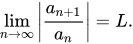
Osamäärätesti tai suhdetesti on tapa tutkia reaali- tai kompleksitermisten sarjojen ∑n=1∞andisplaystyle sum _n=1^infty a_n suppenemista. Testin julkaisi Jean le Rond d'Alembert ja se tunnetaankin joskus nimellä d'Alembertin osamäärätesti. Testiä varten lasketaan sarjan kahden peräkkäisen termin itseisarvon raja-arvo indeksin n lähestyessä ääretöntä ja merkitään saatua raja-arvoa kirjaimella L. Matemaattisesti ilmaistuna

- limn→∞|an+1an|=L.=L.
Saatua raja-arvoa tulkitaan seuraavasti:
- jos L<1displaystyle L<1!, niin sarja suppenee.
- jos L>1displaystyle L>1!, niin sarja hajaantuu.
- jos L=1displaystyle L=1!, niin sarjan suppenemisesta ei voida sanoa mitään osamäärätestin perusteella.


Esimerkkejä |
Suppeneva |
Tutkitaan sarjan
- ∑n=1∞nendisplaystyle sum _n=1^infty frac ne^n

suppenemista. Lasketaan sarjan kahden peräkkäisen termin itseisarvon raja-arvo
- limn→∞|an+1an|=limn→∞|n+1en+1nen|=limn→∞|n+1en+1⋅enn|=limn→∞|n+1n⋅enen⋅e|=limn→∞|(1+1n)⋅1e|=1⋅1e=1e<1.=lim _nrightarrow infty left

Koska raja-arvo L=1edisplaystyle L=frac 1e on pienempi kuin 1, niin sarja suppenee.

Hajaantuva |
Tutkitaan sarjan
- ∑n=1∞enndisplaystyle sum _n=1^infty frac e^nn

suppenemista. Osamäärätestin mukaisesti lasketaan
- limn→∞|an+1an|=limn→∞|en+1n+1enn|=limn→∞|en+1n+1⋅nen|=limn→∞|nn+1⋅en⋅een|=limn→∞|(1−1n+1)⋅e|=1⋅e=e>1.=lim _nrightarrow infty left

Koska L=e≈2,718…displaystyle L=eapprox 2,718dots on suurempi kuin 1, niin sarja hajaantuu.

Testi ei kerro suppenemisesta |
Jos sarjan raja-arvo L on tasan 1 eli
- limn→∞|an+1an|=1,displaystyle lim _nrightarrow infty left
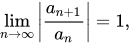
niin osamäärätestillä ei voida selvittää sen suppenemista.
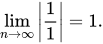
Esimerkiksi sarja
- ∑n=1∞1displaystyle sum _n=1^infty 1

hajaantuu, mutta
- limn→∞|11|=1.frac 11right
Sarja
- ∑n=1∞1n2displaystyle sum _n=1^infty frac 1n^2

puolestaan suppenee itseisesti, mutta
- limn→∞|1(n+1)21n2|=1.=1.

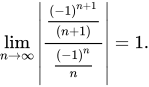
Sarja
- ∑n=1∞(−1)n1ndisplaystyle sum _n=1^infty (-1)^nfrac 1n

suppenee ehdollisesti, mutta
- limn→∞|(−1)n+1(n+1)(−1)nn|=1.=1.
Katso myös |
- Vertailuperiaate
- Juuritesti
- Integraalitesti
Kirjallisuutta |
- Knopp, Konrad, "Infinite Sequences and Series", Dover publications, Inc., New York, 1956. (§ 3.3, 5.4) ISBN 0-486-60153-6
- Whittaker, E. T., and Watson, G. N., A Course in Modern Analysis, fourth edition, Cambridge University Press, 1963. (§ 2.36, 2.37) ISBN 0-521-58807-3
- Pitkäranta, Juhani: Calculus Fennicus. Helsinki: Avoimet oppimateriaalit ry, 2015. ISBN 978-952-7010-12-9, ISBN 978-952-7010-13-6 (pdf).


