Rasvahappometyyliesteri Katso myös | Lähteet | NavigointivalikkoTeoksen verkkoversio10.1002/14356007.a10_245.pub210.1016/j.fuel.2009.08.014ISSN 0016-2361Artikkelin verkkoversioTeoksen verkkoversio/10.1017/CBO978051184418822736811ISSN 0022-300XArtikkelin verkkoversio10.1016/j.watres.2005.10.019ISSN 0043-1354Artikkelin verkkoversio
Esterit
esteriärasvahapostametanolistavaihtoesteröinnilläkasviöljypohjaisissabiopolttoaineissaemäskatalysoiduinnatriumhydroksidianatriummetoksidiakaliumhydroksiasetaaniluku1988triglyseriditrasvahapotkaasukromatografialla
Rasvahappometyyliesteri, eli FAME (eng. Fatty Acid Methyl Ester) tarkoittaa rasvahapon metyyliesteriä, joka on valmistettu rasvahaposta ja metanolista vaihtoesteröinnillä. FAMEt ovat yleisiä kasviöljypohjaisissa biopolttoaineissa.[1] FAMEja valmistetaan yleensä emäs-katalysoiduin reaktioin. Emäksenä käytetään esimerkiksi natriumhydroksidia, natriummetoksidia[2] tai kaliumhydroksia. FAMEja käytetään biopolttoaineiden valmistuksessa koska vapaat rasvahapot voivat syövyttää aikaa myöden moottoreiden metallia, polttoaineen valmistuslaitosten laitteistoja jne. Toisin kuin neutraalit FAMEt, vapaat rasvahapot ovat vain heikosti happamia, mutta niiden käytössä niiden aiheuttama syöpyminen kertyy. Toinen parannus on se, että FAMEilla on myös 12–15 suurempi setaaniluku suhteessa niiden esteröimättömiin muotoihin.[3]
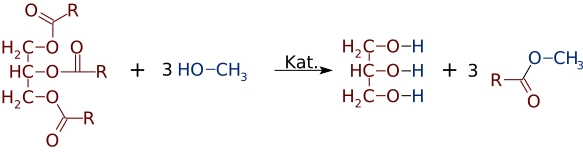
FAMEja on biopolttoaineiden lisäksi käytetty myös bakteeritutkimuksessa vuodesta 1988 asti. Kullakin eliöllä on omanlaisensa rasvahappokoostumus. Metyyliesteröimällä näytteenä otetun bakteerin tai usean bakteerin kolonnian triglyseridit, rasvahapot jne., voidaan ne tutkia kaasukromatografialla ja luoda eliöstä tai kolonniasta profiili.[4] Esimerkiksi jostakin vesistöstä otetun FAME-käsitellyn bakteerinäytteen avulla voidaan vesistö tunnistaa tietyllä varmuudella saastuneiksi ulosteista vertailemalla näytettä bakteeriprofiiliin, jonka bakteerien tiedetään olevan ulosteperäisiä. Jos näytteen ja kannan välillä on kylliksi samanlaisuutta, on vesistö todennäköisesti saastunut, jos ei, saattaa vesistö olla puhdas. Menetelmää kutsutaan MST:ksi (eng. microbial source tracking), ja siinä voidaan käyttää muitakin menetelmiä kuin vain metyyliesteröintiä.[5]
Katso myös |
- Biodiesel
- Esteröinti
- Solvolyysi
- Hydrolyysi
Lähteet |
↑ David J. Anneken, Sabine Both, Ralf Christoph, Georg Fieg, Udo Steinberner, Alfred Westfechtel: ”Fatty Acids”, Ullmann's Encyclopedia of Industrial Chemistry. Weinheim: Wiley-VCH, 2005. OCLC: 910197915. ISBN 9783527306732. Teoksen verkkoversio (viitattu 19.4.2018). doi:10.1002/14356007.a10_245.pub2.
↑ Amish P. Vyas, Jaswant L. Verma, N. Subrahmanyam: A review on FAME production processes. Fuel, 2010, 89. vsk, nro 1, s. 1–9. doi:10.1016/j.fuel.2009.08.014. ISSN 0016-2361. Artikkelin verkkoversio.
↑ Schobert, Harold H: Chemistry of fossil fuels and biofuels, s. 62-64. Cambridge, Englanti: Cambridge University Press, 2013. OCLC: 859139114. ASIN: 0521114004. ISBN 9780521114004. Teoksen verkkoversio. doi:/10.1017/CBO9780511844188.
↑ Nicholas S. Sekora, Kathy S. Lawrence, Paula Agudelo, Edzard van Santen, John A. McInroy: Using FAME Analysis to Compare, Differentiate, and Identify Multiple Nematode Species. Journal of Nematology, syyskuu 2009, 41. vsk, nro 3, s. 163–173. PubMed:22736811. ISSN 0022-300X. Artikkelin verkkoversio.
↑ Duran, Metin; Haznedaroğlu, Berat Z.; Zitomer, Daniel H: Microbial source tracking using host specific FAME profiles of fecal coliforms. Water Research, 1.1.2006, 40. vsk, nro 1, s. 67–74. doi:10.1016/j.watres.2005.10.019. ISSN 0043-1354. Artikkelin verkkoversio.


